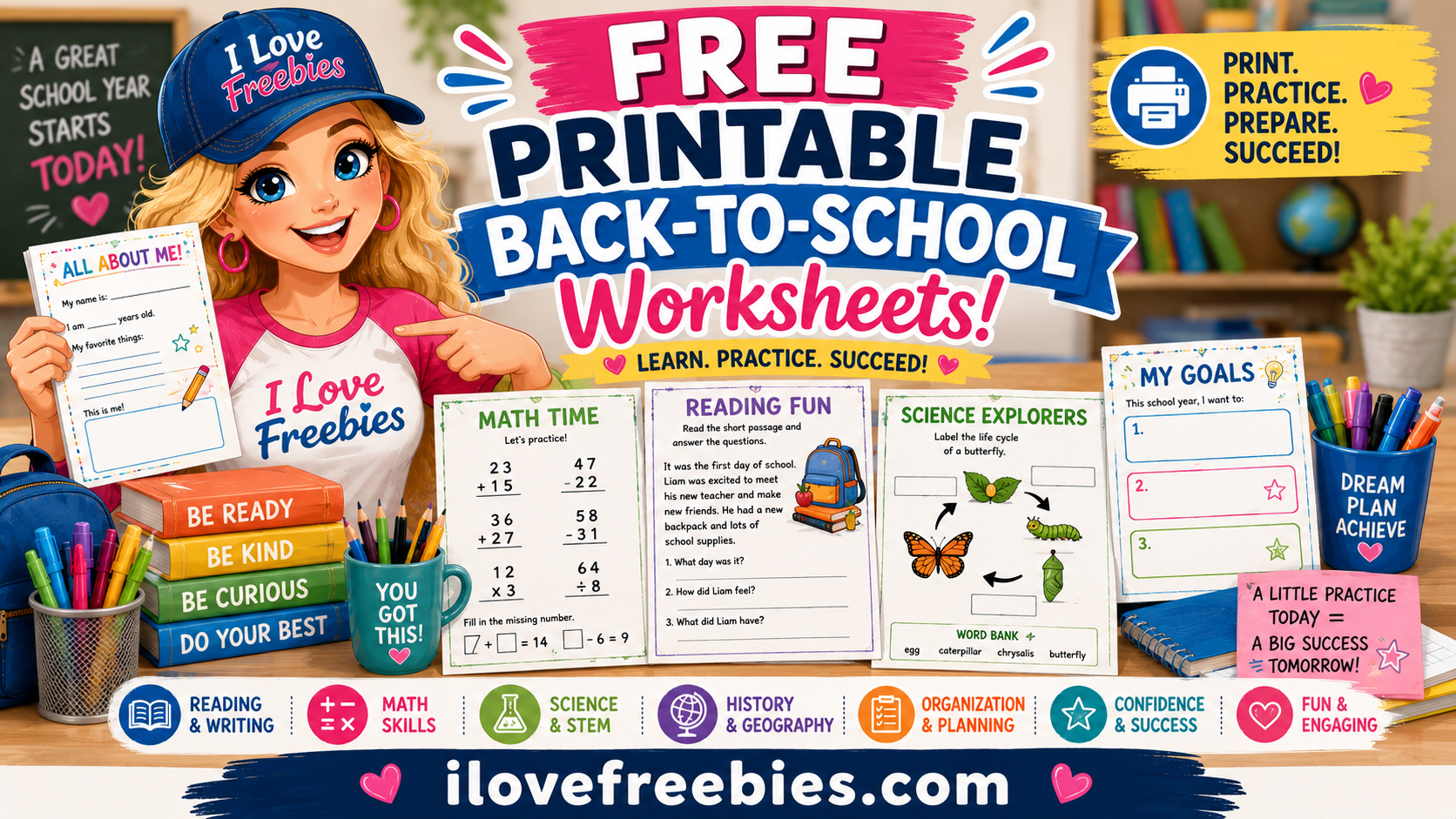
Free printable back-to-school worksheets can help students review important skills, learn new routines, set goals, and return to learning after summer break.
This guide collects trustworthy reading, writing, history, science, organization, and primary-source resources for different grade levels. Most can be printed at no charge, although some sites may require a free account or include optional paid materials.
Choose a Few Useful Pages
Start with one academic review page, one organization sheet, and one goal-setting or getting-to-know-you activity. A focused set is usually more useful than printing a large packet of unrelated worksheets.
1. Reading and Writing Printables
ReadWriteThink Printouts offers free, classroom-tested organizers and writing tools for students from elementary grades through high school. Use the grade and resource filters before printing.
Available printouts include:
- K-W-L charts for recording what students know, want to learn, and learned
- Venn diagrams and T-charts
- Editing and peer-review checklists
- Reading-response and book-review pages
- Writing starters and poetry organizers
- Research notes, presentation rubrics, and planning sheets
Simple first-week prompts can also help a teacher or caregiver learn about a student. Try “Three things I want my teacher to know,” “My goal for this year,” or “A book I enjoyed.” Younger children can draw and dictate their response.
2. Library of Congress Primary-Source Tools
The Library of Congress provides free classroom materials created by teachers. Its Primary Source Analysis Tool and Teacher’s Guides help students observe, reflect, ask questions, and analyze historical items.
The general analysis tool can be completed digitally or printed. Specialized guides cover:
- Books and printed texts
- Charts, graphs, and maps
- Manuscripts and newspapers
- Photographs, prints, and political cartoons
- Motion pictures, oral histories, and sound recordings
Teachers can pair the worksheet with the Library’s ready-to-use classroom materials and primary-source sets.
3. National Archives Document-Analysis Worksheets
The National Archives document-analysis worksheets teach students how to examine historical documents and media instead of simply reading for facts.
Separate versions are available for novice or younger students, English learners, intermediate students, and secondary students. Topics include written documents, photographs, maps, posters, cartoons, artifacts, videos, sound recordings, and artwork. Many pages have illustrated PDF versions that can be downloaded and printed.
Match the Analysis Level
Choose the novice format when students need visual prompts and shorter questions. Intermediate and secondary formats ask for more detailed evidence, context, and interpretation.
4. NASA STEM Worksheets, Activities, and Coloring Books
NASA Learning Resources includes free STEM activities, educator guides, coloring pages, printable projects, videos, and interactive materials for several grade bands.
Students can explore astronauts, rockets, the Moon, planets, the Sun, Earth science, weather, engineering design, and NASA missions. Some activities require simple household supplies, so read the complete directions before printing.
For art-based science activities, browse NASA Coloring and Activity Books. The collection includes downloadable PDFs about space, Earth science, missions, and astronomy. File sizes vary, so preview the book and print only the pages you need.
5. USGS Earth Science and Geography Resources
The U.S. Geological Survey Educational Resources collection covers geology, water, maps, natural hazards, ecosystems, climate, and other Earth science topics.
Materials may include student worksheets, activity sheets, paper models, printable maps, teacher guides, and answer keys. The Water Science School teacher resources are especially useful for printable lessons with student questions and answers.
Check the listed grade range and supplies. Some USGS pages are complete multi-day lessons rather than independent worksheets, and a few older activities may reference unavailable multimedia.
6. Smithsonian Learning Lab Collections
Smithsonian Learning Lab is a free education platform featuring museum images, objects, recordings, texts, videos, and teaching collections.
Use its collections to build activities about American history, art, animals, habitats, inventions, aviation, culture, and famous people. Not every item is a traditional one-page worksheet, but many collections include discussion questions, prompts, handouts, and lesson activities.
Preview the entire collection before assigning it and confirm whether students need individual accounts. Teachers can often present the resource and print only the accompanying handouts.
7. PBS LearningMedia Printables and Lessons
PBS LearningMedia offers thousands of free teaching resources, including videos, lesson plans, games, activities, and printable handouts aligned with grade levels and subjects.
Search by grade, subject, standard, or resource type. The collection includes English language arts, math, science, social studies, health, and arts materials. The Teach Your Way printables are useful for younger students.
Some resources require a free PBS LearningMedia account. A free signup should not require a credit card, but registration and regional availability can vary. Review each activity before giving it to a child because some pages are designed for teacher-led instruction.
8. Back-to-School Worksheets by Grade Level
Preschool and Kindergarten
Choose short activities with large print and space to draw. Useful skills include name writing, line and shape tracing, letter recognition, counting, matching colors, identifying emotions, school vocabulary, and following simple directions. Supervise scissors, glue, and small craft pieces.
Elementary School
Look for reading passages, main idea, parts of speech, sentence writing, place value, addition, subtraction, multiplication, fractions, time, money, maps, and basic science vocabulary. Select work based on current ability rather than the grade label alone.
Middle and High School
Older students may benefit from assignment planners, essay outlines, research organizers, source-evaluation checklists, lab templates, vocabulary trackers, grade logs, and college or career goals. Confirm whether a teacher requires a specific format for graded work.
Free Organization and Goal-Setting Printables
Not every useful back-to-school page needs to be academic. Routine sheets can help students remember materials and manage new schedules.
- Morning and after-school checklists
- Backpack packing lists
- Weekly assignment and homework planners
- Reading calendars and book logs
- School lunch and activity schedules
- Short-term and semester goal pages
- School contact-information sheets
Place a frequently reused checklist in a page protector and use a dry-erase marker. Keep personally identifying details off any page that will be displayed publicly.
How to Choose the Right Worksheet
- Check the recommended grade and reading difficulty.
- Identify the exact skill or routine being practiced.
- Make sure the directions are understandable.
- Look for an answer key when independent checking is helpful.
- Consider writing space, visual complexity, and accessibility needs.
- Verify that facts, terminology, and standards are current.
- Stop if the activity causes unnecessary frustration or is only repetitive busywork.
Print Worksheets for Less
- Preview the complete file before selecting Print.
- Enter only the page numbers you need.
- Use grayscale or black-and-white when color is not instructional.
- Choose double-sided or draft-quality printing when appropriate.
- Reuse clean one-sided paper for informal practice.
- Ask whether your public library offers free or low-cost printing.
Watch for Misleading Download Buttons
Use the download link provided by the original education, museum, nonprofit, or government site. Avoid advertisements that request payment details, install browser software, or download an unexpected file type for an ordinary worksheet.
Worksheet Copyright and Account Reminders
A free download is not automatically free to repost, resell, edit, or upload elsewhere. Check whether the creator permits home use, one-classroom use, school-wide copying, tutoring use, or commercial use. Share the source page instead of uploading someone else’s PDF.
Some sites require a free account or limit downloads. Before registering, check whether a credit card is requested, whether a trial renews, what student data is collected, and how to delete the account. Do not provide banking information, gift-card payment, or unnecessary information about a child for a basic printable.
Helpful Resources
- ReadWriteThink Printouts
- Library of Congress Analysis Tools
- National Archives Worksheets
- NASA Learning Resources
- NASA Coloring and Activity Books
- USGS Educational Resources
- Smithsonian Learning Lab
- PBS LearningMedia
Featured Freebies
Free Goodie Box
Daily Goodie Box gives eligible U.S. residents a chance to receive samples and full-size products. Membership and shipping are free, and no credit card is required. Registration does not guarantee that you will receive a box.
Free Healthy Snack Samples
Qualifying participants may request changing samples of better-for-you snacks. Eligibility, contents, quantities, and shipping availability vary, and submitting the form does not guarantee approval or delivery.
Disclosure: I Love Freebies may earn a commission when you use certain featured links, at no additional cost to you.
Final Thoughts
Free printable back-to-school worksheets work best when each page supports a clear purpose. Begin with a small selection that matches the student’s skills, interests, and new-school-year needs.
Mix academic review with planning, goal setting, creativity, and low-pressure getting-to-know-you activities. That balance can help students feel prepared without turning the first days of school into a stack of busywork.