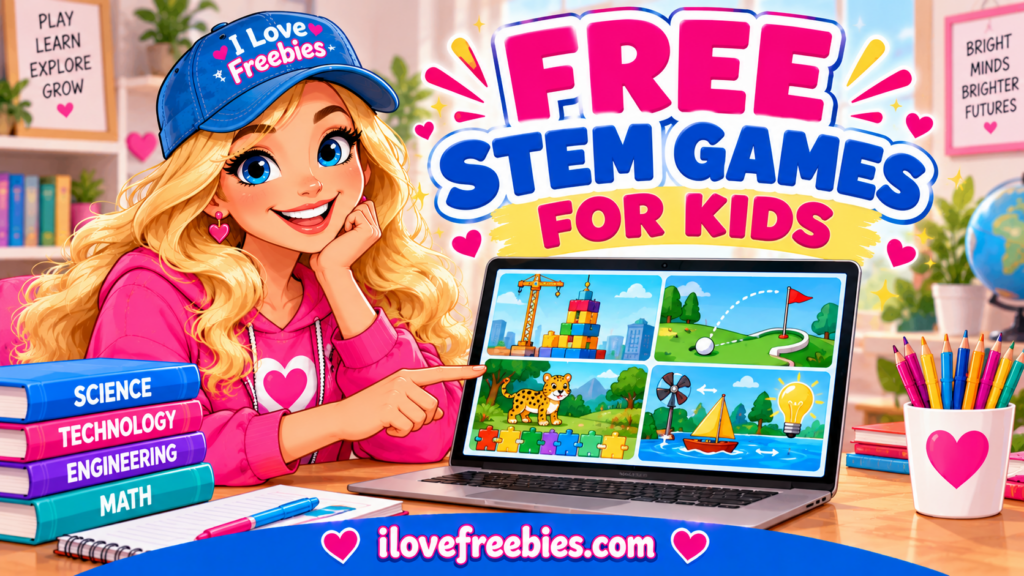
Looking for a fun way to mix screen time with learning? The Smithsonian Science Education Center offers free STEM games for kids that turn topics like engineering, motion, animals, habitats, nutrition, and sustainability into interactive online activities.
Affiliate disclosure: Some links on I Love Freebies may be affiliate links. We may earn a commission when you use qualifying links, at no extra cost to you.
1. Free STEM Games for Kids Online
The Smithsonian Science Education Center offers a collection of free STEM games designed to help children explore science, technology, engineering, and math concepts through play.
The games are created with specific learning objectives and are reviewed by curriculum experts. Instead of simply giving kids another casual browser game, the activities are designed around real educational concepts such as motion, engineering design, animal traits, habitats, nutrition, and problem-solving.
Many of the games can be played directly online, making them an easy free activity for home, school, homeschool lessons, or quiet learning time.
2. What Games Can Kids Play?
The current Smithsonian game library includes several different activities for elementary and middle-grade learners.
One example is Tami’s Tower, an engineering-design game where players help a golden lion tamarin reach food by building a stable tower. Kids experiment with structures while learning basic engineering and problem-solving concepts.
Mini Golf Motion explores physical science and motion through a miniature-golf style activity. Showbiz Safari teaches children about animal traits, habitats, and biodiversity by having players select animals for different movie roles.
The Game Center also includes activities such as Shutterbugs: Wiggle and Stomp, which helps younger children learn about movement and motion through animals.
3. How to Play the Free Smithsonian Games
Use the button above to open the Smithsonian Science Education Center Game Center.
Browse the available games and choose one based on your child’s age, grade level, or interests. Each listing identifies the general subject area and the grade levels the activity is designed to support.
Click the game you want to explore and follow the on-screen instructions. Depending on the activity, a game may open directly in a browser or provide another free way to access it.
No paid game subscription is required to access the free resources listed in the Smithsonian Game Center.
4. Turn the Games Into a Fun Learning Activity
These games can be more useful when parents or teachers connect the activity to something children are already learning.
For example, after playing an engineering game, kids could try building a tower from blocks, cups, or recycled materials. After playing a game about animal habitats, families could look up the real animals featured in the activity and learn where they live.
Children interested in motion could experiment with toy cars, balls, ramps, or homemade mini-golf obstacles after completing a physical-science game.
Combining the digital game with a simple hands-on activity can turn a short online session into a longer STEM learning experience without purchasing a special kit.
5. Great for Home, Homeschool or Classroom Use
The free STEM games can work in several different settings. Parents can use them as an educational rainy-day activity, teachers can incorporate selected games into science lessons, and homeschool families can use them to reinforce topics being covered in a curriculum.
Because the Game Center identifies grade levels and subjects, adults can quickly find activities that are more likely to match a child’s current learning level.
Some games are designed for younger elementary students, while others reach into upper elementary and middle-school grades. This makes the collection useful for families with children of different ages.
The games can also be a fun option when kids want screen time but parents would prefer something with an educational purpose.
6. More Than Just Science Trivia
These are not simply multiple-choice trivia quizzes. Many of the Smithsonian activities ask kids to solve problems, experiment, make choices, recognize patterns, or apply what they are learning.
Tami’s Tower, for example, centers on engineering design and building a solution to a problem. Mini Golf Motion connects gameplay to concepts involving force and motion. Other games explore animals, ecosystems, nutrition, and sustainability. :chatgpt-content-reference{index=”2″}
This problem-solving approach can help children see STEM subjects as something they can interact with rather than information they only read in a textbook.
7. Are the Smithsonian STEM Games Really Free?
Yes. The Smithsonian Science Education Center specifically identifies its STEM games as free resources. Its current Game Center states that it offers free Smithsonian STEM games online or for download. :chatgpt-content-reference{index=”3″}
There is no purchase required to access the core free games described in this post.
Families will need internet access and a compatible device for browser-based activities. Some games or related resources may also have downloadable or app-based versions, so always check the individual game page for the current access options.
This freebie covers the educational games themselves and does not include physical science kits, computers, tablets, or printed classroom supplies.
8. Final Thoughts
Free STEM games are a great way to give kids something entertaining to do while also encouraging curiosity about science, engineering, animals, motion, and problem-solving.
The Smithsonian Science Education Center provides several games designed around clear educational goals, with options for different elementary grade levels and subject areas.
Whether you need an educational rainy-day activity, an extra homeschool resource, a classroom game, or simply a better kind of screen time, this free collection is worth exploring.